Best RO
Borewell, tanker or TDS over 500

Aquaguard Delight Aquasaver
The most complete RO+UV+UF package here, with the longest filter life and the best water-recovery claim.
₹11,499
Check on Amazon See all 14 RO picks →Best water purifiers in India · Buying guide
Most people pick a purifier by counting stages on the box. That's backwards. The right purifier depends on what's in your water. Answer three quick questions and we'll tell you which type fits.
This guide is research-based: we analysed Indian drinking water standards, WHO, CDC and US EPA guidance, 340 water purifier listings on Amazon.in, and the verified owner reviews of the purifiers in our roundups. We do not test products ourselves. We may earn a commission on links to Amazon at no extra cost to you.
Our top picks
We compared 46 purifiers across four roundups, one per type. Here is the one we'd buy from each.
Best RO
Borewell, tanker or TDS over 500
The most complete RO+UV+UF package here, with the longest filter life and the best water-recovery claim.
₹11,499
Check on Amazon See all 14 RO picks →Best UV + UF
City tap water with low TDS
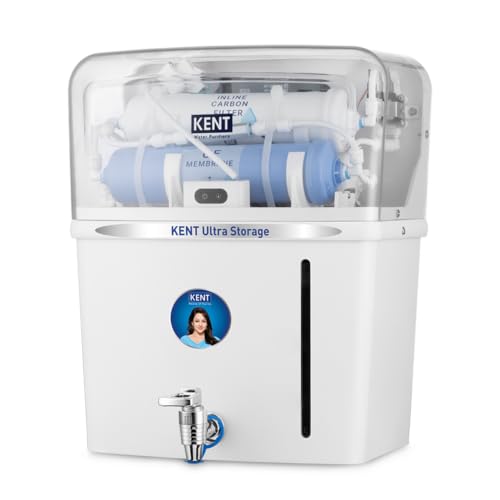
The best-evidenced, most capable UV+UF purifier in this list.
₹7,799
Check on Amazon See all 12 UV + UF picks →Best Gravity
City water, no steady power or plumbing

The gravity purifier India actually buys: cheap, easy to find and backed by a real service network.
₹2,999
Check on Amazon See all 6 Gravity picks →Best Under-sink
High-TDS water, no counter or wall space

The slimmest, smartest under-sink purifier here, if you can live with a young service network.
₹20,990
Check on Amazon See all 14 Under-sink picks →Step one
TDS stands for Total Dissolved Solids: the salts and minerals mixed invisibly into water. It's measured in mg/L, which is the same as ppm. Drag the slider to see what a reading means.
Low TDS. Normal for treated city water.UV + UF or gravity is usually enough. Very low readings (under about 50) can taste flat.
A low number does not mean safe water. A TDS meter can't see germs, and it can't spot small but harmful amounts of fluoride, arsenic or lead. If you drink borewell water, a lab test is the only way to know. India's groundwater survey found about 20% of samples over the nitrate limit, 9% over the fluoride limit and 3% over the arsenic limit.[3]
Limits from India's drinking water standard IS 10500: 500 mg/L is the acceptable limit, and 2,000 mg/L is allowed only when no other source exists.[1] WHO sets no health limit for TDS; its guidance is about taste. Water under 300 tastes excellent, and very low TDS can taste flat.[2]
Meet the machines
Almost every purifier on Amazon is built around one of these. The rest of the stuff on the box is extras.
Reverse osmosis. Think of it as a sieve so fine it catches salt.
Pick it for: borewell, tanker, or TDS over 500. Best RO purifiers →
A germ-zapping light plus a very fine strainer.
Pick it for: city water with low TDS. Best UV purifiers →
No plug, no tap connection. Water just trickles down.
Pick it for: city water, no steady power, renters. Best gravity purifiers →
Need RO but short on counter or wall space? Under-sink RO purifiers hide in the cabinet and give you a slim tap. See our best under-sink water purifiers.
A net for sand, rust and mud. It's in almost every purifier and protects the other stages.
A sponge for chlorine smell and bad taste. It traps germs but doesn't kill them, so it's never enough alone.[7]
The stickers on the box
Most RO purifiers on Amazon now add these on top. Of 250 RO listings we analysed, only 27 had none of them. Here's our verdict on each.
Adds a little calcium and magnesium back after RO strips them out. Research published by WHO backs having some minerals in drinking water.[8]
Not needed on UV + UF or gravity, which never removed them.
Mixes some water that skipped the RO back in, to raise the mineral level. The catch is that anything bad in your source water comes back too.
Fine for salty but otherwise clean water. Avoid it if your water has fluoride or arsenic.
A study found copper pots killed germs, but only after the water sat in them for 16 hours.[11] A copper stage in a purifier gets seconds. Treat it as a taste feature.
India's standard sets a tight copper limit of 0.05 mg/L.[1]
Reviews of the research found no clear health benefit over normal mineral water.[9],[10] Don't pay extra for it.
India's standard says drinking water should stay between pH 6.5 and 8.5.[1]
A small UV light inside the storage tank. It keeps stored water from picking up germs again. It is not an extra purification stage.
Seen on Kent, Pureit, Livpure and Native models.
Brands count every filter, cartridge and add-on as a stage. A 10-stage purifier isn't twice as good as a 5-stage one. Check which core technology it uses.
Many budget RO listings claim 10 or more stages.
Label decoder
These are the combinations we saw most across 340 purifier listings on Amazon.in.
| You'll see | What it means | Good for |
|---|---|---|
RO + UV + UF | RO with a UV lamp and UF after it. The most common combination, especially from budget brands. | Borewell, tanker, high TDS |
RO + UV | Same idea without UF. That isn't a weakness, because the RO membrane is already finer than UF. | Borewell, tanker, high TDS |
RO + UF + UV LED tank | RO plus UF. Here the UV only keeps the tank clean. | Borewell, tanker, high TDS |
RO + MF | Pureit's naming. MF is a filtration stage after RO. | Borewell, tanker, high TDS |
UV + UF | No RO. Kills and strains out germs and keeps minerals. | City water, low TDS |
UV only | A sediment and carbon filter, then UV. No fine strainer, so it depends on clear water. | Clear city water, tight budget |
Gravity + UF | No electricity. Water drips through a UF membrane. | City water, no power |
MTDS / taste adjuster | A TDS controller: some unfiltered water is mixed back in. | See the stickers section |
Quick answers
It depends on your water. For treated city water with low TDS, a UV + UF purifier such as the KENT Ultra Storage UV+UF is enough and wastes no water. For borewell, tanker or water over 500 ppm TDS, you need RO, and our pick is the Aquaguard Delight Aquasaver. See all our UV picks and RO picks.
Measure your TDS first. Under about 200 on city water, UV + UF is enough. Over 500, or on borewell water that could carry fluoride or arsenic, choose RO.[1],[4] Between 200 and 500 is within India's acceptable limit, so check the TDS rating of the UV model you pick.
RO water is safe to drink. The concern is that it has very few minerals. Research published by WHO suggests drinking water with some calcium and magnesium is better over the long term.[8] If you need RO, choose one with a mineral cartridge.
Treated city water can pick up germs from old pipes and rooftop tanks on its way to you. A UV + UF or gravity purifier handles that without wasting water.
Only if counter and wall space is the problem. Almost every under-sink model is an RO purifier hidden in the cabinet, so it suits borewell, tanker and high-TDS water, and it costs more than a wall-mounted RO. Installing one usually means drilling for a slim dedicated tap, and the unit has to fit around your plumbing and dustbin. See our under-sink picks.
No. In 2019 India's National Green Tribunal asked the government to stop RO use where TDS is under 500. The Supreme Court put that order on hold in March 2022.[12] RO is legal everywhere, but it's still unnecessary for low-TDS water.
Use it to wash floors, flush toilets or wash your vehicle. India's pollution board has proposed exactly these uses in its 2026 draft guidelines.[13]
Look for the ISI mark with a licence number. Since November 2024, Indian rules require purifier makers to get a BIS Standard Mark.[14] An NSF listing is a bonus, but it only covers the claims it names.
Health, safety and cost claims in this guide are backed by the authoritative sources below.

Naveen Bhavnani — Founder, ChefPicks
Naveen Bhavnani founded ChefPicks to cut through the noise around kitchen-appliance buying in India. His work is research and analysis — comparing specs, pricing, warranties and real buyer feedback across every category to surface the picks that are genuinely worth your money.