Place Settings: How Many Do You Actually Need?
A 'place setting' includes a dinner plate, soup bowl, dessert plate, glass, cup, saucer, knife, fork, and spoons for one person. For Indian households: a family of 4 generates 8-10 place settings per meal (including serving bowls, kadhais, and extra utensils). 12-13 place settings handles a family of 4 comfortably with cooking vessels. 14-15 place settings is ideal for families of 5+ or those who prefer running the dishwasher once daily after accumulating two meals' worth of dishes.
Countertop vs Full-Size: Which is Right for Your Kitchen?
Full-size (60cm width): Fits under standard kitchen counters, requires plumbing installation (water inlet + drain), handles kadhais, pressure cookers, and tawas. Essential for Indian families of 3+. Countertop (50-55cm): Sits on your counter, connects to kitchen faucet, no permanent plumbing needed. Cannot fit large Indian cooking vessels. Ideal for: couples, bachelor apartments, rental homes where you can't modify plumbing, or as a supplementary unit for daily dishes while you hand-wash large pots.
Indian Cooking & Dishwashers: Setting Realistic Expectations
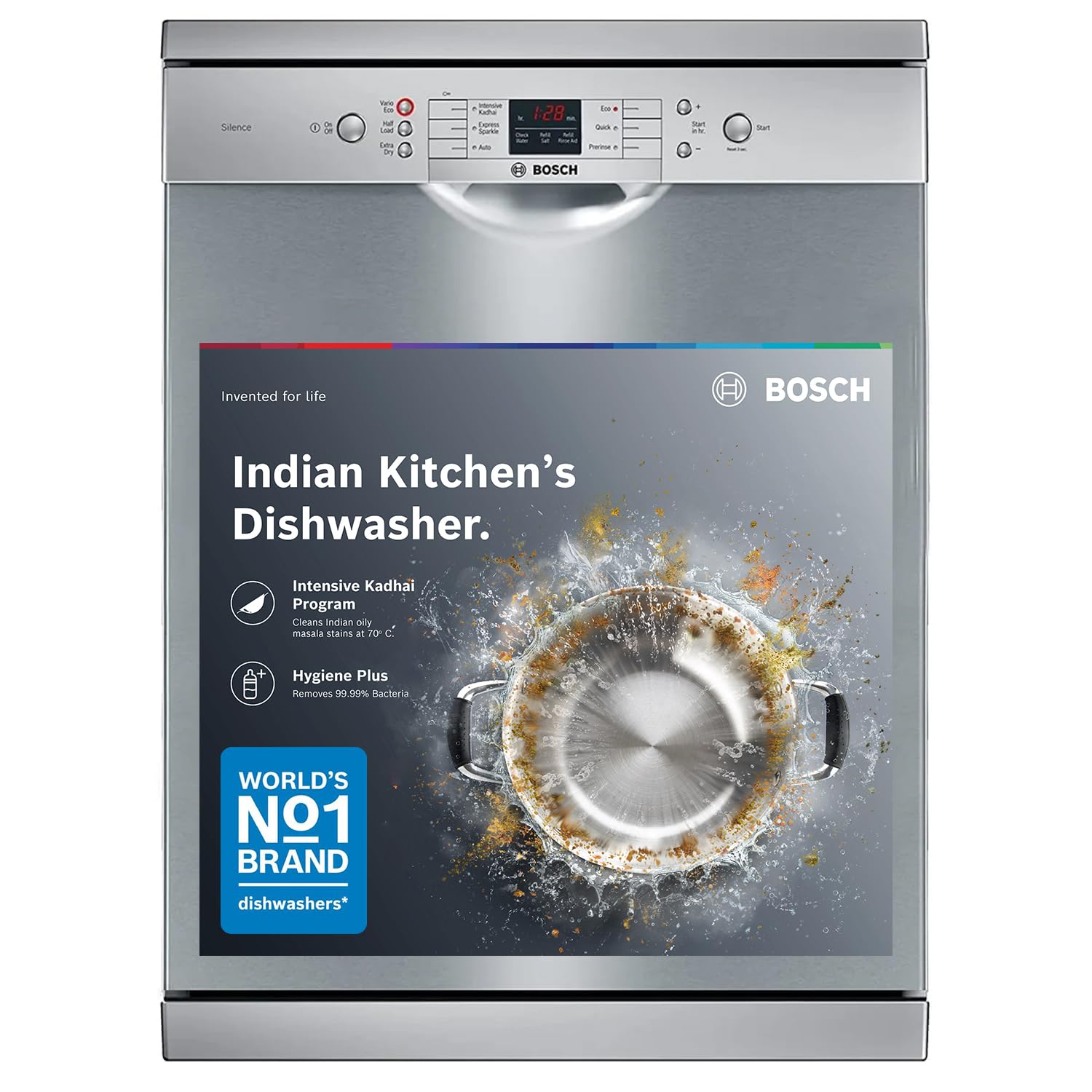
No dishwasher handles every Indian cooking scenario perfectly. Heavily burnt/charred pans need soaking first. Milk vessels with dried residue benefit from a pre-rinse. Oily kadhais clean best on 70°C Intensive programs. Turmeric stains may persist on plastic containers. Stainless steel and ceramic clean beautifully. The key insight from thousands of Indian user reviews: a dishwasher handles 90% of daily dishes perfectly. The remaining 10% (badly burnt, heavily crusted items) need a quick soak before loading.
Water Consumption: Why It Varies So Much
Dishwashers in India range from 9L to 17L per cycle - a massive difference over hundreds of cycles. The most efficient models here line up with global benchmarks: Energy Star-certified full-size dishwashers cap water use at roughly 12L (3.2 gallons) per cycle.[2] For context, independent research on manual dishwashing finds hand-washing a full load can use around 100L of water - far more than any machine here; even a routine Indian load runs 40-60L by hand.[3] So even the least efficient dishwasher (17L) saves water vs hand-washing. At Rs.80/1000L (average metro water cost), the difference between 9L (Bosch) and 17L (Faber) is Rs.5-6 per cycle - roughly Rs.150/month if you run it daily. Over 5 years, that's Rs.9,000 in water savings alone, not counting the electricity to heat that extra water.[1]
Drying Technologies: Condensation vs Zeolith vs AirDry
Condensation (budget models): Residual heat evaporates water which condenses on cooler tub walls. Cheapest but least effective - dishes come out damp, especially plastics. Tip: open the door 5 minutes after the cycle ends. AirDry/Auto-open (Electrolux, Hafele): Door automatically opens a few centimeters post-wash, letting air circulate naturally. Effective in dry climates (Delhi, Bangalore), less so in humid coastal cities (Mumbai, Chennai). Zero energy cost. Zeolith/PerfectDry (Bosch premium): Minerals absorb moisture and release heat - active drying without electricity. Best results but only available in Rs.60,000+ models. Turbo (IFB): Fan blows warm air. Good middle ground between condensation and Zeolith.
After-Sales Service: The Hidden Differentiator
In India, after-sales service can make or break your dishwasher experience. Based on thousands of reviews: Bosch - Excellent service, reliable spare parts, responsive in metros. IFB - Best pan-India coverage, same-day response in many cities, understands local needs. Electrolux - Growing network, good in metros, less presence in tier-2 cities. Faber - Consistently poor reviews for after-sales service, long wait times for spare parts, this alone can be a dealbreaker. Midea - Improving rapidly but network still sparse. Hafele - Good for kitchen hardware but dishwasher-specific service is unproven. Tip: Always buy extended warranty for dishwashers - spray arms, pumps, and door seals are the most common failure points after year 3.