Steel vs Wood vs Plastic — Which Material Should You Pick?
Steel boards are the most hygienic and durable — they're non-porous, won't absorb odours, and last virtually forever. They're ideal for meat, fish, and turmeric-heavy Indian cooking. Wood boards are the kindest to your knives and look beautiful, but need regular oiling and can't go in the dishwasher. Plastic boards are the lightest, cheapest, and easiest to maintain — perfect for quick daily prep. Many Indian kitchens benefit from having at least two: a steel or plastic board for daily veggie chopping, and a wood board for bread/dough prep or when you want a gentler cutting surface.
What Does '304 Grade' Steel Mean and Why It Matters
304-grade stainless steel contains 18% chromium and 8% nickel, making it highly resistant to rust and corrosion. Cheaper boards may use lower-grade steel that can rust near the edges after a few months. If you're buying a steel board, look for '304' or '18/8' in the description — it's worth the slight premium for food safety and longevity.[1]
Wood Type Matters: Teak vs Acacia vs Sheesham
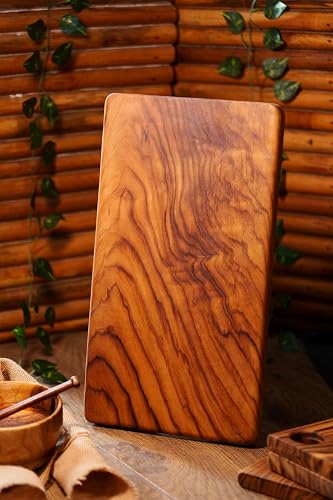
Teak is the gold standard — naturally oily, water-resistant, and antimicrobial. It's also the most expensive. Acacia is a budget-friendly alternative with similar durability but less natural oil content. Sheesham (Indian Rosewood) is very hard and durable but can be rougher on knife edges. Mango wood is soft, knife-friendly, and affordable but less water-resistant. For most home cooks, acacia or mango wood offers the best balance of quality and price.
End Grain vs Flat Grain: Why Construction Matters
End grain boards have the wood fibres pointing upward, so your knife sinks between them rather than cutting across. This means less knife dulling and the board 'self-heals' minor cuts. Flat grain boards are cheaper and lighter but wear faster and are harder on knives. If you're investing in a wood board, end grain is worth the premium — it's the difference between a board that lasts 3 years and one that lasts 10.
Size Guide for Indian Kitchens
For daily vegetable chopping, 35-40 cm boards work well for most 2-3 BHK kitchen counters. If you roll roti or knead dough on the board, go for 40 cm or larger. For small kitchens or single-item prep, compact 30-33 cm boards save counter space. Always measure your available counter space before buying — the board needs to sit flat without overhanging.
Weight Is a Quality Indicator for Steel Boards
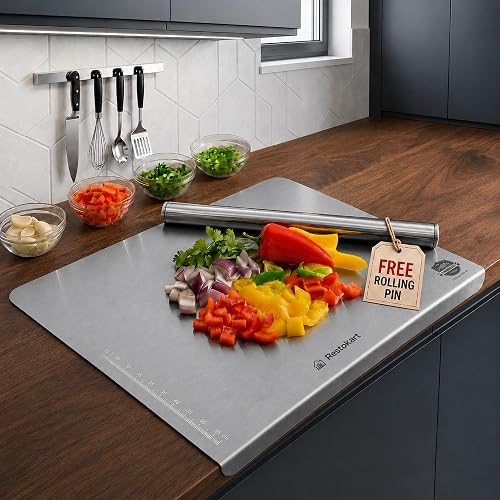
Heavier steel boards use thicker gauge steel, which means better warp resistance and stability during chopping. Look for boards weighing at least 700g for standard sizes. Ultra-light steel boards (under 400g) often warp within months. The heaviest board in our roundup (Restokart at 1,093g) is virtually impossible to move during aggressive chopping — that's exactly what you want.
Plastic Board Thickness: The Spec You're Ignoring
Most budget plastic boards are 3-5mm thin and develop deep knife grooves within weeks — these grooves harbour bacteria and make the board unsanitary. Look for boards at least 1 cm thick, or ideally 2 cm like the SWIFT INTERNATIONAL. Thicker boards resist warping, show fewer knife marks, and last significantly longer. If you're buying a thin board, plan to replace it every 6-12 months.
How to Maintain Your Chopping Board
Steel boards: wash with soap and water after each use, dry immediately to prevent water spots. Wood boards: wash by hand (never dishwasher), dry upright, oil with food-grade mineral oil every 2-4 weeks. Plastic boards: dishwasher safe in most cases, but replace when deep knife grooves appear. For all types: use separate boards for raw meat and vegetables to prevent cross-contamination — colour-coded plastic boards make this easy.