Wattage is the headline number and the most exaggerated one
Hand blenders in India are sold on wattage, and the figure on the box is frequently not what you get. Among the reviews we analysed, verified owners of two separate 1000W models said they could not puree tomatoes or churn white butter, and several judged a claimed 1000W unit far too light to house a motor of that rating. Treat the number as a rough class indicator rather than a measurement: under 300W handles lassi, soups and baby food only; 450-600W covers most Indian kitchen work including chutneys; 1000W is what you want for thick batters and larger volumes. A well-designed 450W unit from a brand that engineers its blade geometry will out-blend a generic 1000W with a flat four-blade head, which is why the 450W Braun MultiQuick 1 scores close to some 1000W rivals on blending.
Which brand should you actually buy?
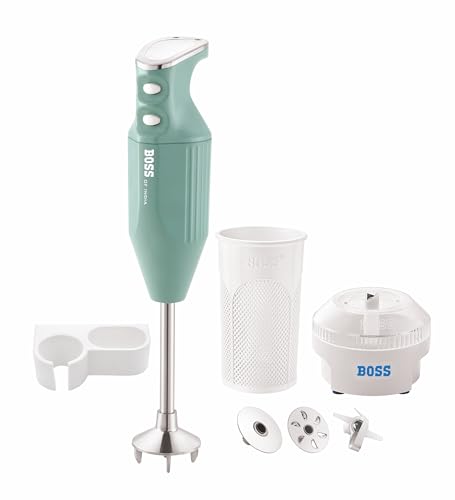
There is no single best hand blender brand in India — each one wins on a different axis, and the right answer depends on which failure you would rather avoid. Braun has the strongest reliability record here, with 0-13% negative rates across the last hundred verified Indian reviews on its models, but its sub-₹3,000 units arrive with a beaker or nothing at all and carry only a 1-year warranty. Philips sells the most units by a wide margin and has the widest service network in the country, which genuinely matters outside the metros, but its 300W single-trigger unit is the weakest performer in this roundup. AGARO gives you the most specification per rupee — 1000W and multi-step speed control around ₹2,000 — with the best-documented replacement service in the category, and you will probably need it, since 22-28% of recent verified buyers rated its models one or two stars. Hafele offers the most metal under ₹3,000 but owners report it running hot. Tefal, made in India by Groupe SEB, has the longest blade warranty and domestic service but no verified Indian review record at all yet. BOSS covers its motor for five years, longer than anyone.
Speed control matters more than most buyers expect
The difference between a two-speed switch and a twenty-step dial is the difference between chutney that is coarse or liquid and chutney that is exactly right. It also matters for safety and mess: starting slow keeps hot soup in the pot rather than up your arm. In this field, speed counts run from a single fixed speed to 25 steps plus turbo, and the price does not track it — a ₹1,699 AGARO Regency offers eight speeds plus turbo while a ₹2,899 Braun offers exactly one. Decide first whether you want fine control or brand engineering, because at the sub-₹3,000 level you will rarely get both.
Read the spec table, not the title — they often disagree
This is the single most useful habit for buying any small appliance on Amazon.in. Across the listings we examined, three claimed one wattage in the title and a different one in the technical specification table, two claimed Made in Europe while declaring China as the country of origin, and several described stainless steel construction on units whose Material Type field read Plastic or Metal, Plastic. One reviewer discovered only after delivery that the blade-end cover was plastic despite the description implying steel. Scroll to the Technical Details block before you buy, and where the two contradict each other, believe the spec table.
The plastic parts are what break, not the motor
Reading several hundred verified Indian reviews across this category, the failure pattern is remarkably consistent and it is almost never the motor burning out first. What breaks is the plastic coupling where the blending shaft joins the motor body, the plastic collar around the blade, the chopper jar lid, and the release button. Owners describe fittings snapping on first use, attachments working loose mid-blend, and couplings tearing on the metal rod. When comparing two models at a similar price, look specifically at how the shaft attaches — a twist-lock metal collar is meaningfully more durable than a plastic push-fit — and treat a long warranty on the motor alone as covering the part least likely to fail.
Overheating is the category-wide complaint, and it is partly a usage issue
Heat came up in verified reviews of nearly every model we examined, from ₹1,449 to ₹6,399. Some of that is genuine build quality, but a large share is duty cycle: these are small motors with no cooling fan, designed for bursts rather than continuous running. One Indian owner reported that after a warranty repair, the technician instructed him never to run the unit beyond thirty seconds at a stretch. That is not an unreasonable instruction, it is simply one that almost no listing states. If you plan to blend large batches, buy a higher-wattage unit and rest it between passes; if a blender gets hot after five minutes of continuous use, that is closer to normal than to defective.
Check what the warranty actually covers before you value it
Warranty terms in this category are quoted loosely and rarely mean what the headline implies. The BOSS Big Boss advertises five years, which turns out to be five years on the motor and one year on every other part — and as established above, the other parts are what break. Tefal splits its cover the other way, two years on the product and seven on the blades. Some Indian-brand listings offer a two-year term where the second year is conditional on registering the product within 30 days of purchase. Before treating a long term as a reason to buy, find out which components it covers and whether it requires registration, and be aware that several verified owners in this research reported first-year breakages where the claim was simply refused.